Inside
Inside the Basilica Cistern: What You'll Actually See
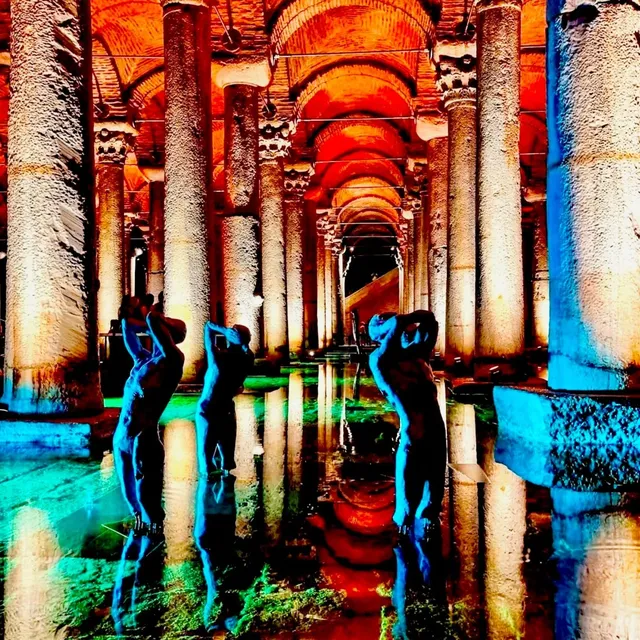
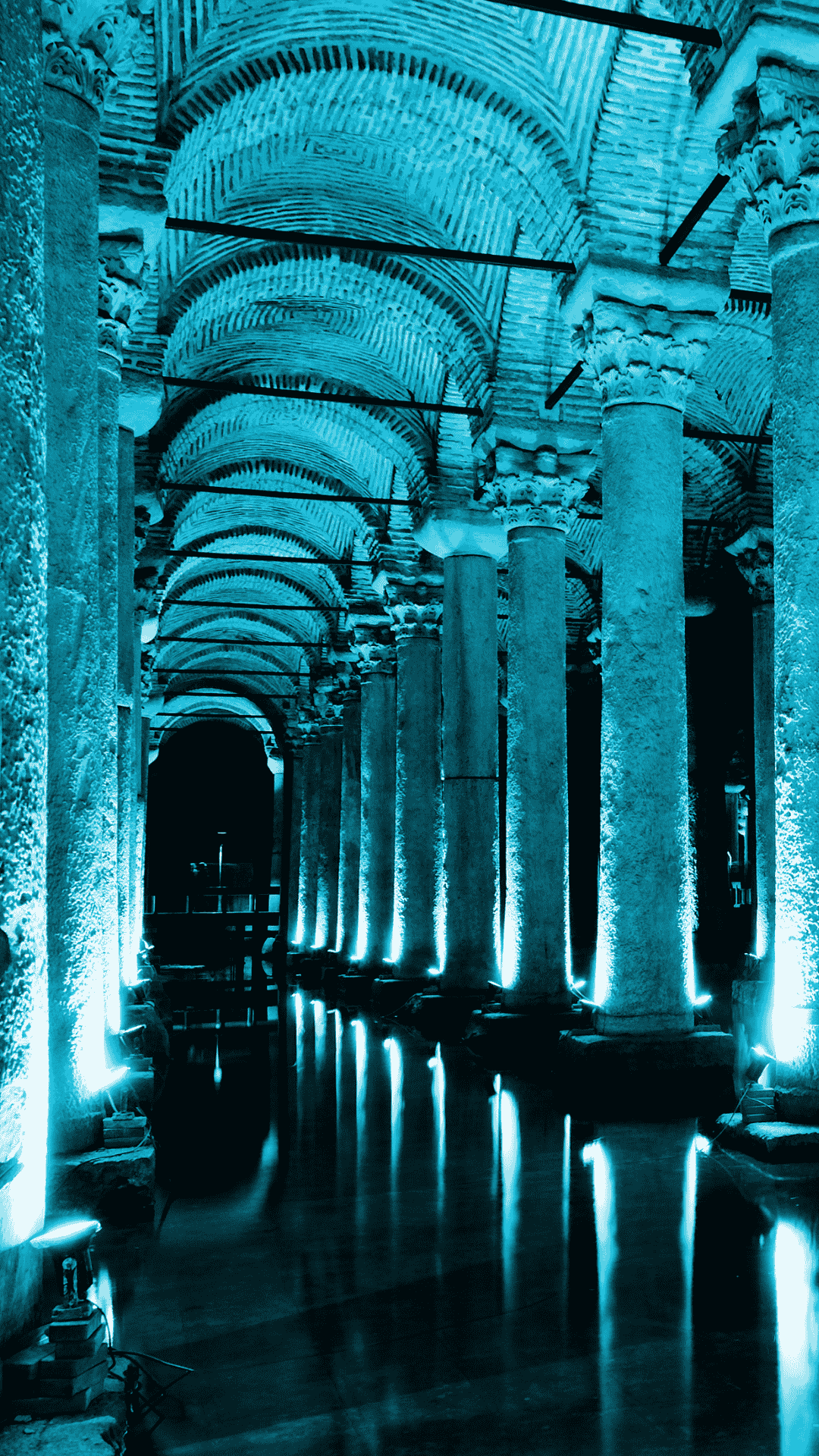
So what is actually down there? You walk down 52 steps and the city disappears. What replaces it is a hall of 336 columns in twelve orderly rows, each nine meters tall. Together they hold the old city's floor above a sheet of shallow water. The columns match nowhere, and that is the point. They are spolia — pieces reused from older Roman temples and shrines. As a result, Corinthian capitals stand next to plain ones and granite next to marble: a warehouse of the ancient world holding up Byzantium's plumbing. Carp glide between the reflections, as they have for as long as anyone has written about the place. The air sits noticeably cooler than the street; likewise, sound drops to drips and footsteps.
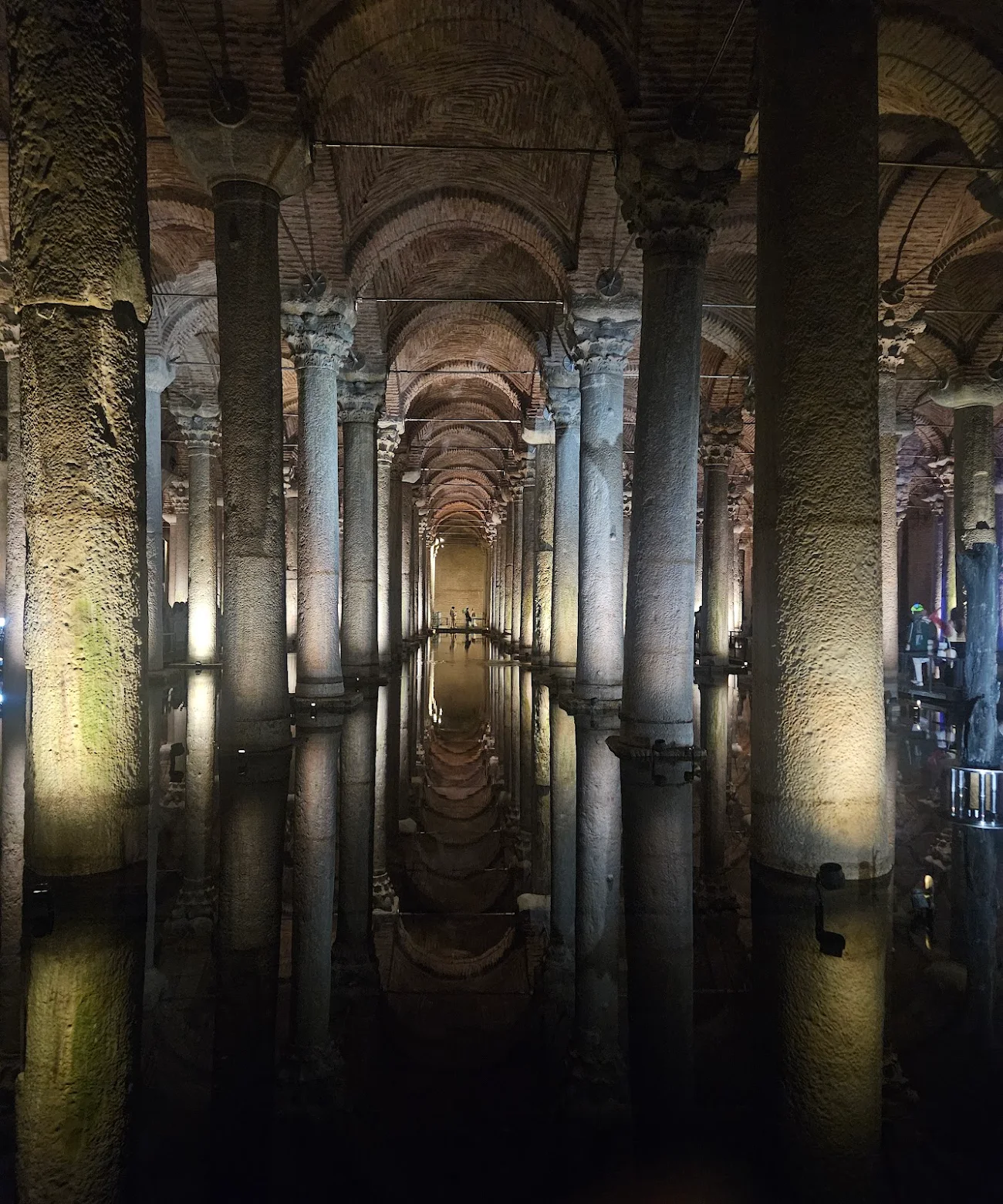
The visit runs on raised walkways from the 2022 works. They loop you through the column forest at water level. Our team measured the full loop at a slow twenty minutes of walking; the rest of your time goes to standing still. In our experience, forty-five minutes covers it without rushing; notably, the first fifteen belong to your eyes adjusting. Since reopening, the cistern has also hosted changing art and light shows among the columns; consequently, no two years down here look quite alike.
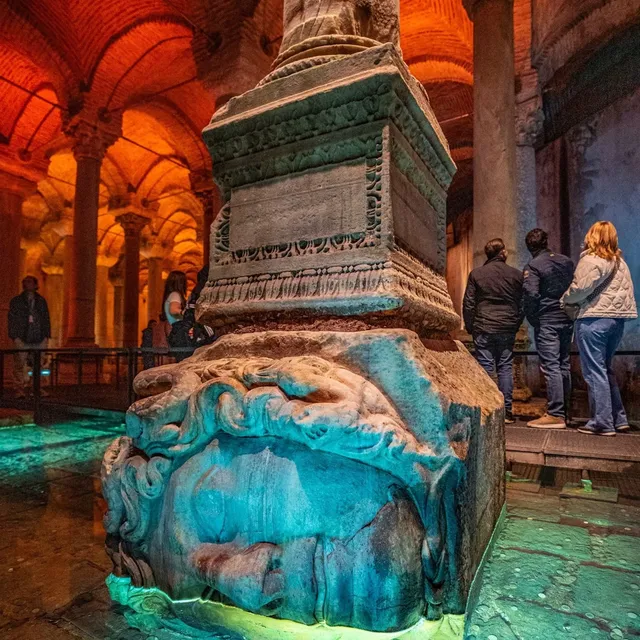
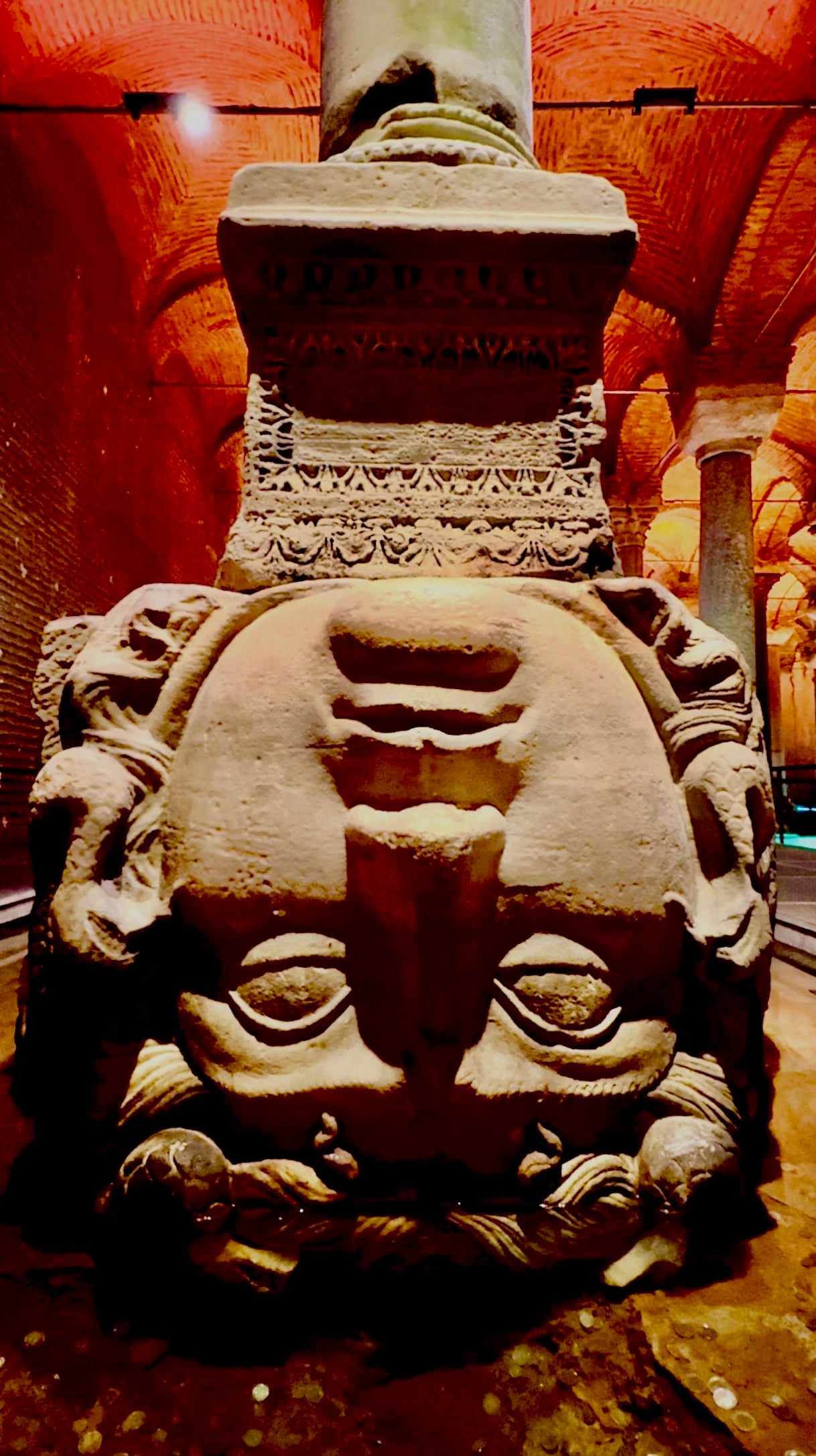
Which stops matter most? Two anchor every visit. In the northwest corner wait the two Medusa heads — one sideways, one upside-down — serving as column bases and as the cistern's great riddle. Nearby stands the Tear Column, carved with peacock-eye patterns and permanently damp — the source of the site's saddest legend. Tradition says it weeps for the enslaved workers who died building the hall; the count of "7,000" attached to that story is folklore rather than record. Similarly, both riddles get their honest treatment below.
History
Basilica Cistern History: Justinian's Water Machine
Start with the name, because it confuses everyone. The Basilica Cistern is named for what stood above it: the Stoa Basilica, a Roman-era trade and law hall on the First Hill. When fires from the Nika Revolt wrecked the neighborhood, Emperor Justinian I rebuilt grandly. Hagia Sophia rose up the road; meanwhile, beneath the ruined stoa, in 532, came this reservoir. The scale still reads like infrastructure showing off. The hall runs roughly 138 by 65 meters, about 9,800 square meters. It stored some 80,000 cubic meters of water, piped in from forests kilometers away. Turks later named it Yerebatan Sarayı — the Sunken Palace — which is more honest about how it feels. A palace stores power; this stored water — and, in fact, with the same swagger.
Then Istanbul forgot it existed. After the Ottoman conquest the cistern slipped out of use, and then out of memory. In the 1540s the French scholar Petrus Gyllius, poking around the neighborhood, found locals unaware of the lake beneath their houses. He measured the hall, counted the columns — all 336 of them — and, consequently, put the Sunken Palace back on the map. In fact, some households above had been quietly drawing water, and stories say fish, through holes in their floors all along.
The Medusa heads deserve honesty, not mystery-selling. The Medusa bases are two Roman column pedestals carved with the Gorgon's face, placed one sideways and one upside-down. Spolia refers to exactly this habit — building new things from the carved bones of older ones — and the cistern is Istanbul's densest showcase of it. Scholars mostly read them as practical: good-sized recycled blocks, orientation incidental. Popular tradition, on the other hand, insists on purpose — turn the Gorgon over and her petrifying gaze turns off. Notably, nobody saw them for centuries either way. The 1985-87 city works drained decades of mud and brought them back to light.
The building's latest chapter is its cleanest. The works that finished in July 2022 removed 1,440 cubic meters of 20th-century concrete and 1,600 more of silt. In addition, it exposed the original sixth-century brick floor for the first time in living memory. As a result, today's visitor sees more of Justinian's actual building than any tourist before them. Hollywood, for instance, got there earlier: From Russia with Love rowed through in 1963, and Inferno sprinted through in 2016.
Plan your visit
Basilica Cistern Tickets & Hours: The 2026 Situation
Tickets and the management change
Here is the honest current picture. In June 2026 the cistern passed from the city to the state's General Directorate of Foundations. It closed briefly and reopened on 6 June under the new management; meanwhile, the transfer was still in the courts when we last checked. Accordingly, prices are in reset. The last posted foreign tariff was 1,950 TL for daytime and 3,000 TL for the evening session; the new schedule had not appeared at our last check. Expect the on-site ticket office to be the source of truth for a while. Treat any price you read online — including this one — as a snapshot. We will keep this page current as the new tariff lands.
Hours and the night session
The daytime pattern runs daily from 9am. The famous evening session — the cistern at its moodiest, lights low and crowds thin — was a fixture of the old regime. Whether it continues under the new management is, for now, unconfirmed. In contrast, the underground constant holds: it is always cool down there — jacket-worth even in August, and part of why summer middays queue longest.
How to get there
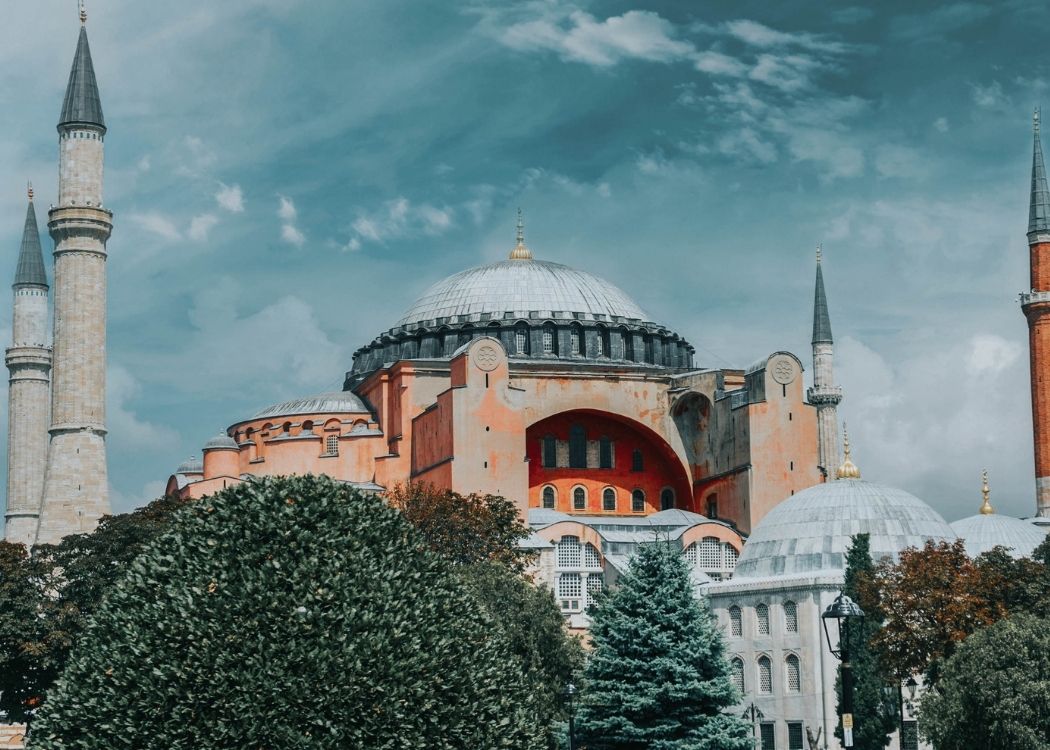
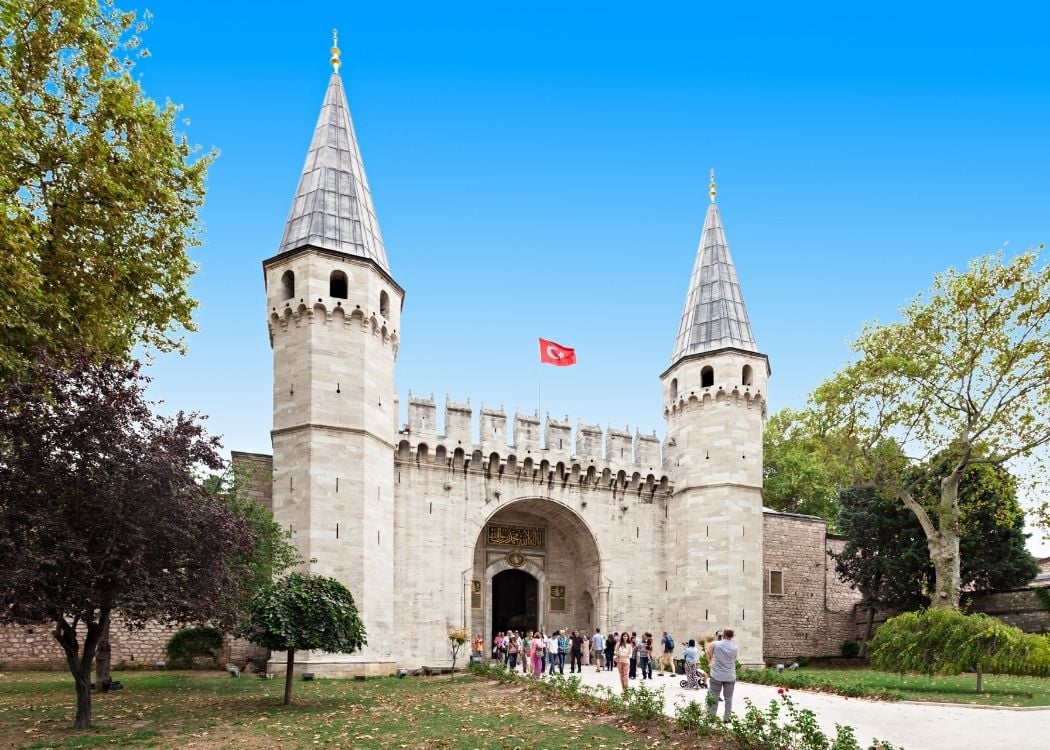
Take the T1 tram to Sultanahmet; the entrance sits about 150 meters from Hagia Sophia, across the square on Yerebatan Caddesi. For example, the classic sequencing: Hagia Sophia at opening, the cistern as your midday escape from the heat, Topkapı after. The queue forms on the street — there is no courtyard to hide in — so timing matters more here than at the neighbors.
Best time to visit
First hour of the day, without contest. We found the walkways nearly private at 9:15am, and shoulder-to-shoulder by noon in summer. Likewise, if an evening session is running when you visit, it is the connoisseur's slot: fewer people, deeper shadows, and the columns doubling in the black water. Midday is for those who enjoy queues.
Fact-checked against official sources · September 1, 2026 · TURSAB-licensed operator
Tours
Basilica Cistern Tickets & Tours
Given the ticketing reset, booking a guided or skip-line option makes more sense than usual. The operators track the current rules, so you do not have to. A guided visit also solves the cistern's real problem. It is spectacular but silent; without the stories — Gyllius counting columns, Medusa upside-down, Justinian's fires — you are looking at very beautiful plumbing. In addition, if your Istanbul plan runs on a pass, check whether the cistern is currently included before assuming. Live prices and availability sit on the cards below.
FAQ
Frequently Asked Questions
Prices are in reset after the June 2026 handover. The last posted foreign tariff was 1,950 TL for daytime and 3,000 TL for the evening session. Check the official channels or the on-site office for the current figure, and treat online prices as snapshots for now.
Yes. It closed briefly during the June 2026 handover and reopened on 6 June under the new state operator. Daily visits run from 9am; the evening session's future under the new management is not yet confirmed.
Two Roman column bases carved with Medusa's face, in the northwest corner — one lying sideways, one upside-down. Scholars mostly call them reused blocks placed for fit; legend says they were flipped to switch off the Gorgon's gaze. They were uncovered during the 1985-87 restoration.
It was built in 532, under Emperor Justinian I, after the Nika Revolt fires cleared the district. That makes it nearly 1,500 years old, and the largest of Istanbul's ancient cisterns.
Forty-five minutes to an hour covers the walkway loop comfortably. Add time for photos at the Medusa heads, which collect the only real bottleneck.
Yes — it is the most haunting room in Istanbul, and since the 2022 works you walk on routes above the original Byzantine floor. It pairs perfectly with Hagia Sophia, 150 meters away.
For the Stoa Basilica, the Roman-era public hall that once stood above it. The Turkish name, Yerebatan Sarayı, means "Sunken Palace" — named for how it looks rather than what it was.
Yes — carp glide through the shallow water among the column reflections, a detail visitors have reported for centuries. They are the cistern's only permanent residents.
Still have questions?
Our Istanbul travel experts are happy to help.
Nearby