Basilica Cistern
Step off the bustling streets of Sultanahmet, descend a flight of worn stone steps, and enter a world that feels separated from Istanbul by fifteen centuries. The Basilica Cistern — known in Turkish as Yerebatan Sarnıcı, the "Sunken Palace" — is one of those rare places where a single visit reshapes how you think about an entire city.
Built in 532 AD during the reign of Emperor Justinian I, this vast underground reservoir once stored water for the Great Palace of Constantinople and surrounding buildings on the First Hill. Today it stands as one of the most haunting and atmospheric monuments anywhere in the Mediterranean world. Walking its raised platforms among 336 marble columns — each one salvaged from temples and civic buildings across the Roman Empire — you move through a space where Byzantine engineering, mystery, and modern art converge in near-total silence broken only by the soft dripping of water.
This guide covers everything you need to visit the Basilica Cistern in 2026: its layered history, what to see once you descend, how to get tickets, practical tips to avoid crowds, and how to combine it with Istanbul's other great landmarks just steps away.
History & Origins of the Basilica Cistern
From the greatest construction project of sixth-century Constantinople to a forgotten ruin beneath Ottoman streets, the cistern's story spans nearly fifteen hundred years.
The story of the Basilica Cistern begins with one of history's most ambitious rulers. Emperor Justinian I, who reigned from 527 to 565 AD and gave Constantinople both the Hagia Sophia and its legal code, ordered the construction of this underground reservoir in 532 AD. It was part of a wider infrastructure plan to secure the city's water supply during times of siege, ensuring that the imperial capital could survive even if its aqueducts were cut.
The site chosen sat beneath a large public square known as the Stoa Basilica — a grand civic basilica built during the earlier reign of Emperor Constantine — which is how the cistern acquired its name. Historical accounts record that as many as 7,000 enslaved laborers worked to carve out the massive subterranean chamber: 140 meters long and 70 meters wide, capable of holding approximately 80,000 cubic meters of water. The water was channeled through aqueducts originating in the Belgrade Forest, roughly 19 kilometers north of the city.
A Forest of Columns from a Fallen Empire
Rather than quarry fresh stone, Justinian's engineers repurposed columns from ruined temples, forums, and public buildings across the former Roman provinces. This is why the 336 marble columns standing in twelve rows of twenty-eight are not uniform. Some are Corinthian, others Ionic or Doric. Some are plain, others intricately carved. They represent fragments of the Roman world reassembled underground in service of a new Christian empire. Walking among them is like passing through the wreckage of one civilization arranged to support the foundation of the next.
Each column stands 9 meters tall, and the weight of the vaulted brick ceiling — along with the earth, pavement, and buildings above — rests on their capitals. Byzantine architects used herringbone-patterned brickwork to distribute the load, a technique so effective that the cistern has survived 1,500 years of earthquakes, fires, and the construction of a modern city on top of it.
The Forgotten Centuries
After the Ottoman conquest of Constantinople in 1453, the cistern entered a long period of obscurity. The Ottomans developed their own water distribution systems and had little need for the Byzantine reservoir. Local residents appear to have known about it — stories persisted of people who could lower buckets through holes in their floors and draw up water, and occasionally fresh fish — but the cistern itself was essentially forgotten by the wider world.
It was not until 1545 that the French scholar Petrus Gyllius, in Istanbul researching the remnants of Byzantine Constantinople, heard these local stories and decided to investigate. Following directions from neighborhood residents, he descended through the basement of a wooden house and found himself in the vast underground chamber, its columns rising from still water. His written account reintroduced the cistern to European scholarship, though it would take centuries more before it became the accessible landmark we know today.
From Silver Screen to World Heritage
The cistern received an unexpected surge in international attention in 1963, when it appeared in the James Bond film From Russia with Love. The filmmakers used the eerie, water-filled chambers to represent a secret underground waterway, and the resulting footage gave audiences around the world their first glimpse of this extraordinary space. Tourism increased, but the cistern remained difficult to visit and structurally precarious for decades.
The transformation came between 1985 and 1987, when the Istanbul Metropolitan Municipality organized a massive restoration effort. Workers removed an estimated 50,000 tons of accumulated mud and silt. Raised wooden and concrete walkways were installed above the water level, new lighting was introduced, and the cistern opened as a museum for the first time. The most recent renovation, completed in 2022, added contemporary light and sound installations, improved pathways, and a revised layout that reveals the cistern's architecture more dramatically than at any previous point in its modern history.
What to See Inside the Basilica Cistern
Five highlights that define a visit, from the column forest to the art that now inhabits the ancient space.
The 336 Marble Columns
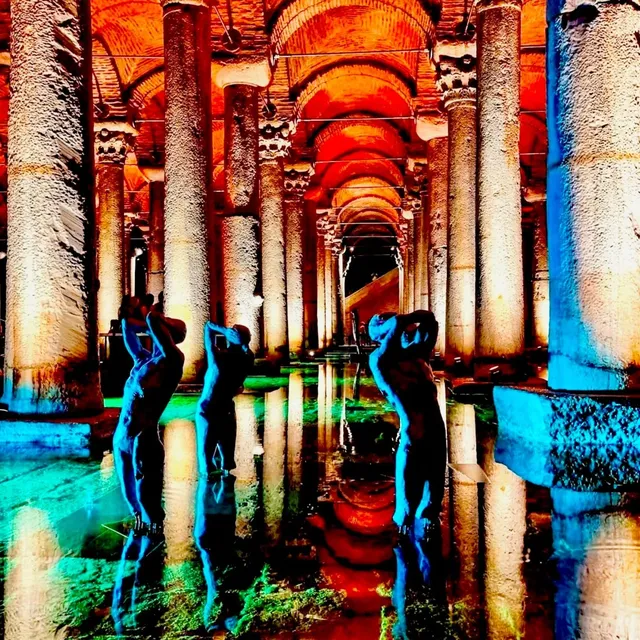
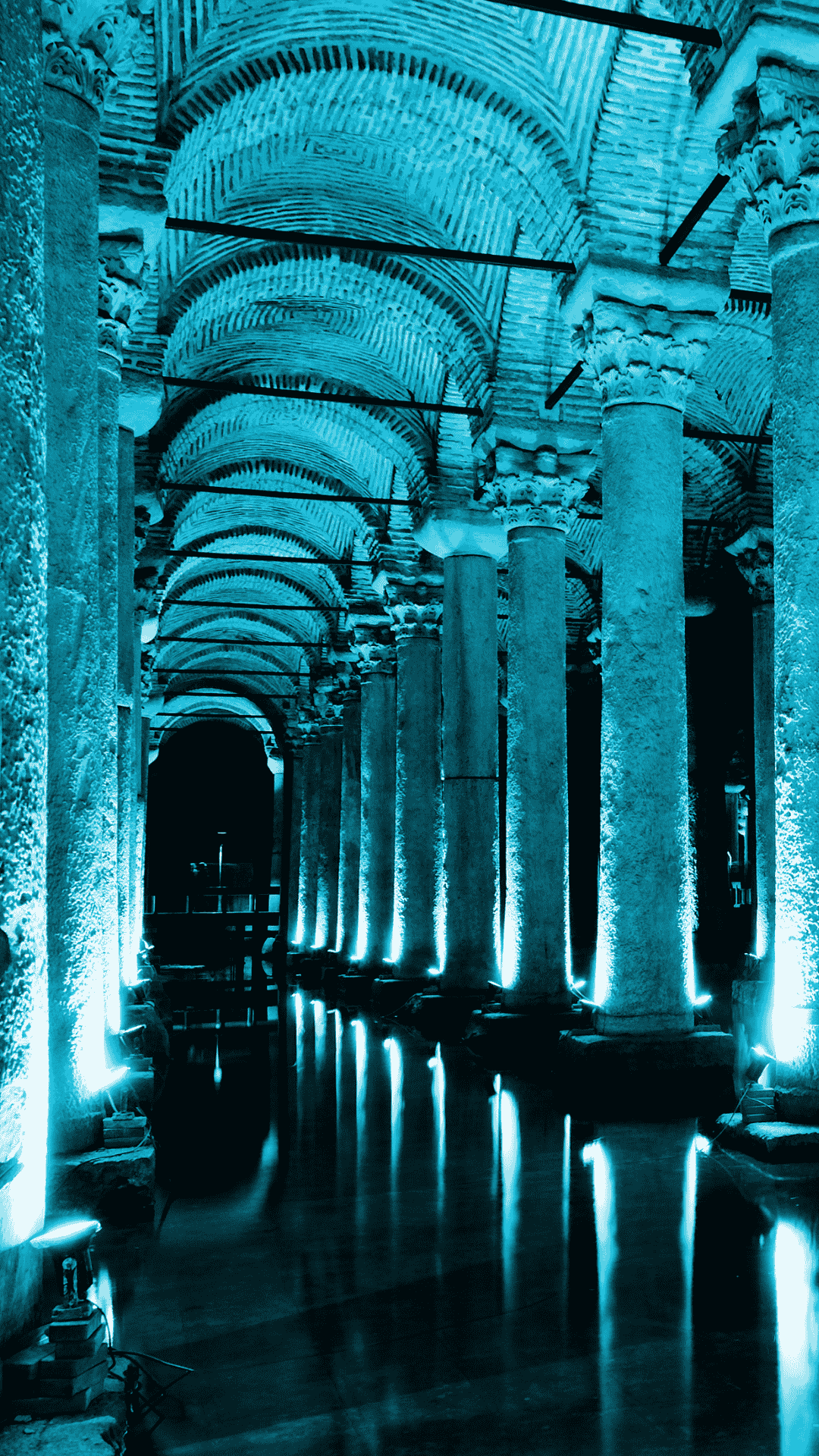
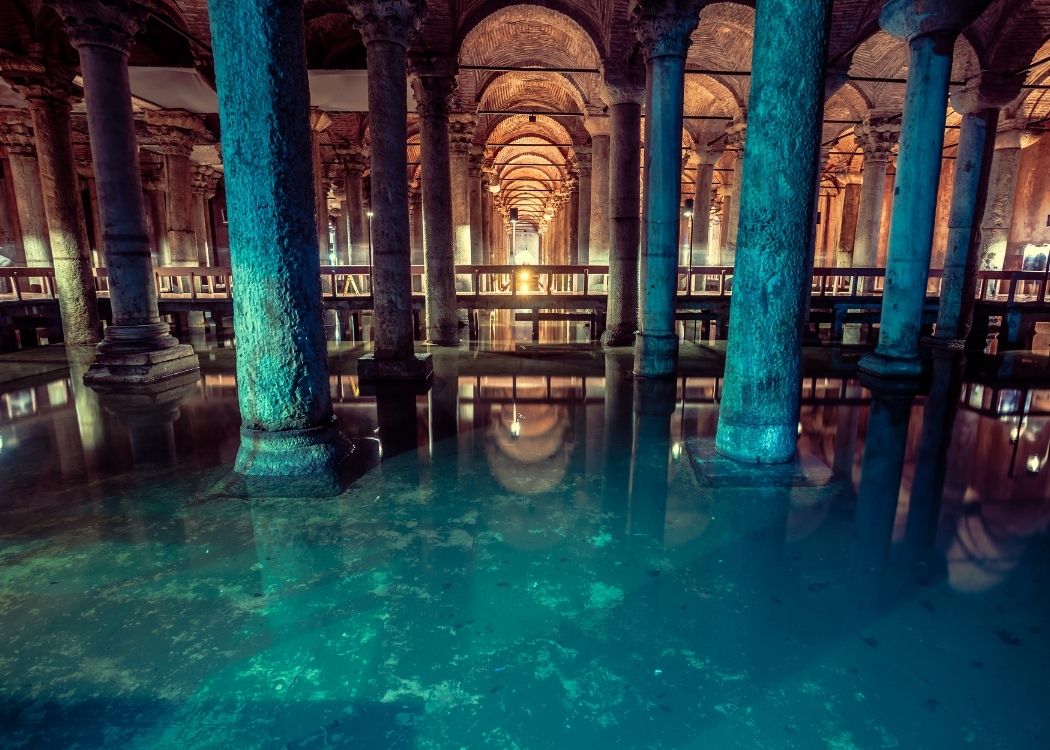
The moment you descend the stone steps and your eyes adjust to the dim lighting, the scale of the cistern announces itself: 336 columns arranged in twelve rows of twenty-eight, each rising 9 meters to meet the arched brick ceiling. What makes this column forest truly extraordinary is its variety. Because Justinian's builders repurposed architectural elements from ruins across the former Roman Empire, no two columns are exactly alike. Some feature finely carved Corinthian acanthus-leaf capitals, their details still crisp after fifteen centuries. Others are simpler Doric shafts, smooth and unadorned. A few bear spiral fluting, others are faceted, and some carry faint traces of inscription from their original public buildings. The effect is that of a gathering of survivors — fragments of lost Roman temples, forums, and bath complexes given new purpose beneath the streets of Constantinople. As you walk the raised platforms between them, the columns are reflected in the shallow water below, doubling the visual depth and making the space feel genuinely limitless.
The Medusa Heads
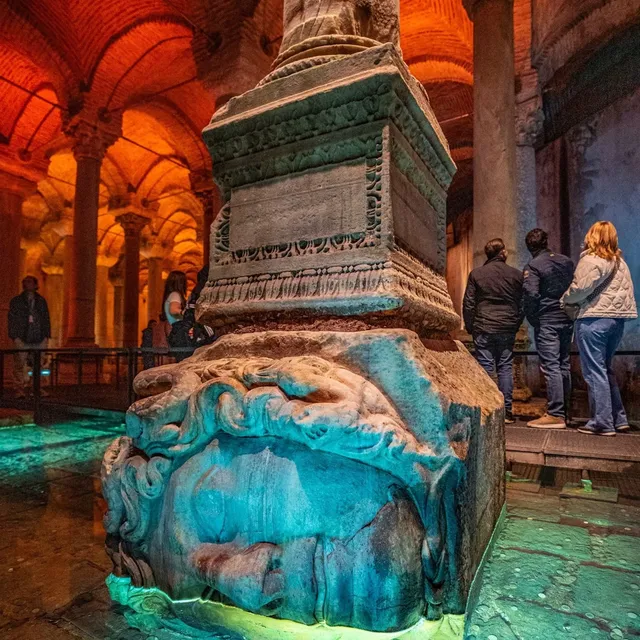
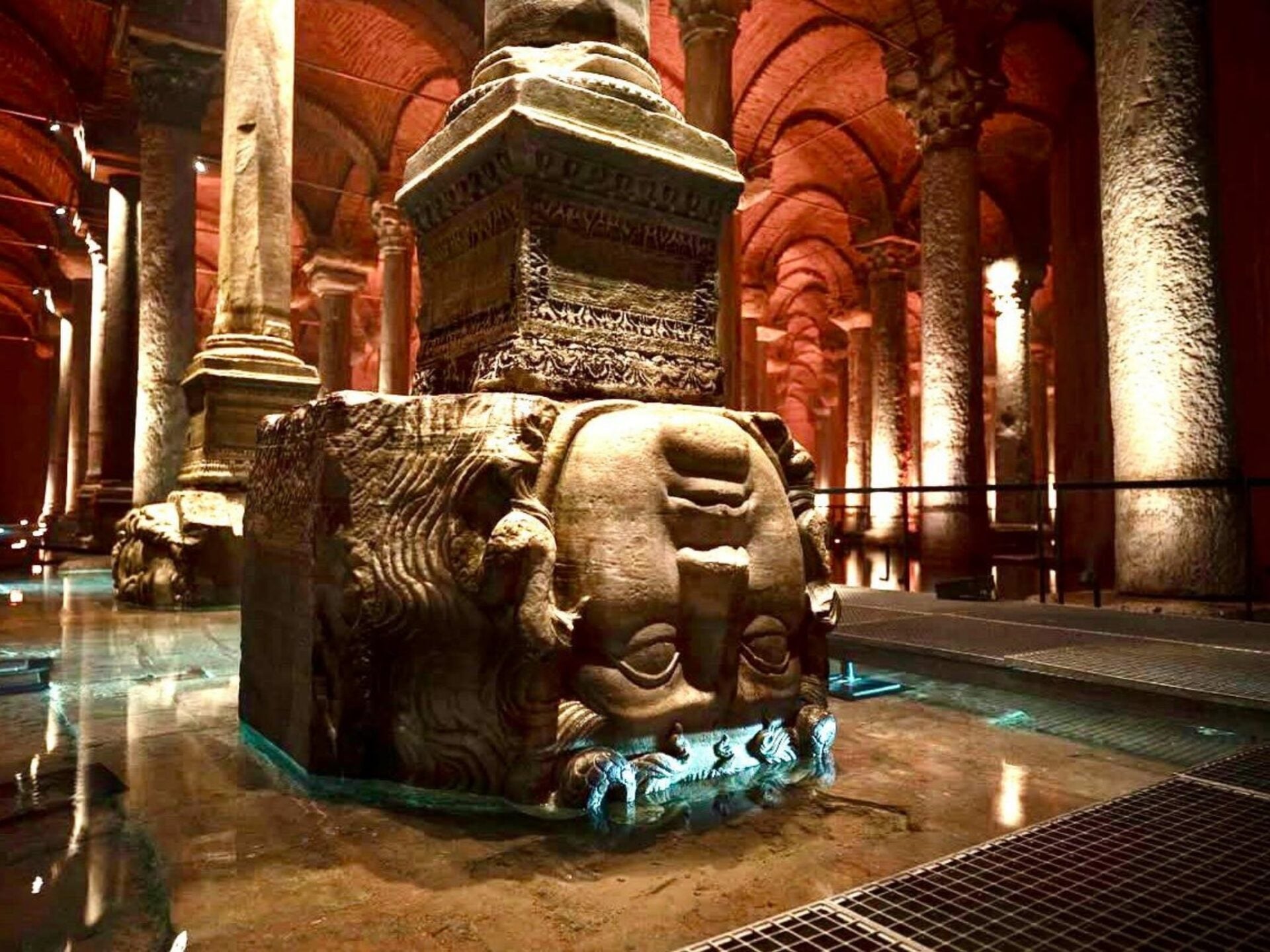
In the northwest corner of the cistern, two carved Medusa heads serve as column bases — and they are, without question, the cistern's most photographed and most debated feature. One head is placed on its side, the other completely upside down. The carving is Roman in style and of exceptional quality, with Medusa's serpent-wreathed face rendered in fine detail despite serving a purely structural purpose. Theories about their placement abound. Some scholars argue the unusual orientations were purely practical: the masons needed blocks of a certain height to support the columns, and the Medusa heads happened to fit when positioned at those angles. Others see the arrangement as deliberately apotropaic, with Medusa's gaze turned away to neutralize her mythological power to turn onlookers to stone. A third theory suggests the builders simply did not care about the pagan imagery and treated the heads as raw material. Whatever the truth, encountering these two ancient faces in the dimness of the cistern — one gazing sideways into eternity, the other staring upward through the column above — is one of Istanbul's most memorable moments.
The Weeping Column
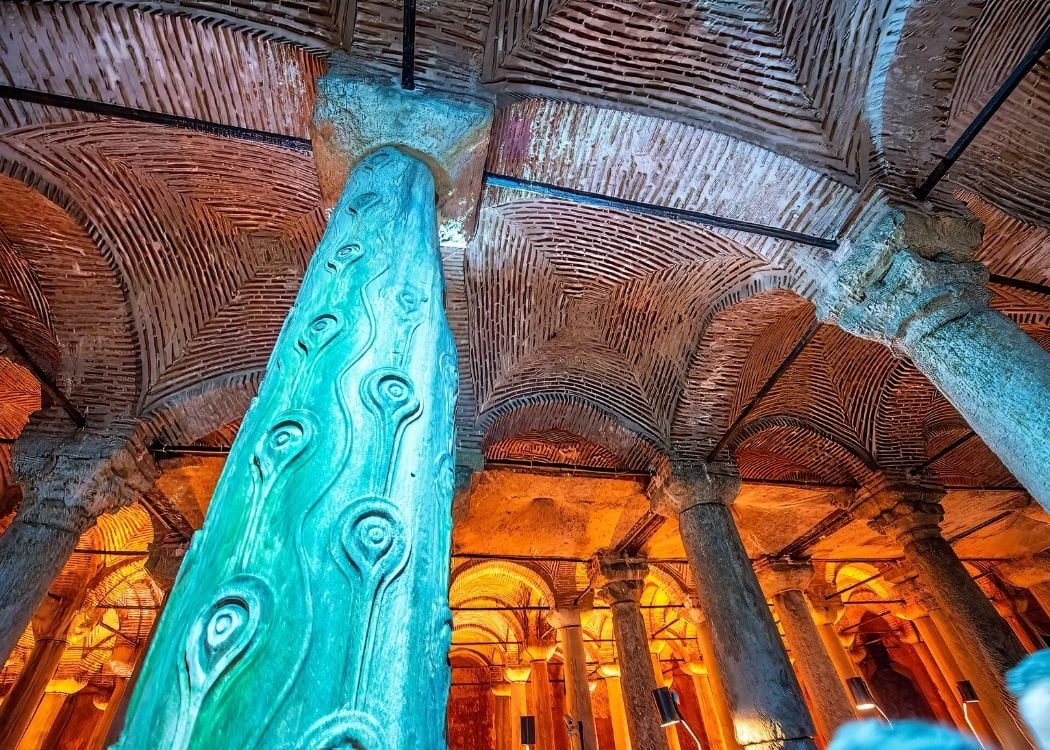
Among the hundreds of columns, one stands apart: the so-called Weeping Column, also known as the Hen's Eye Column, located roughly in the center of the cistern. Its surface is covered with a pattern of raised teardrop shapes and what resembles a carved peacock eye, and the stone perpetually glistens with moisture. Legend holds that the column weeps in memory of the thousands of enslaved workers who died during the cistern's construction. There is also a tradition — similar to the thumb-inserting custom at Hagia Sophia's sweating pillar — that placing your thumb into the carved depression and rotating it in a complete circle will grant a wish. Whether or not you believe in the magic, the column is a striking visual element, its surface gleaming differently from every surrounding shaft and carrying a palpable sense of age and human cost.
Water Features & Light Installations
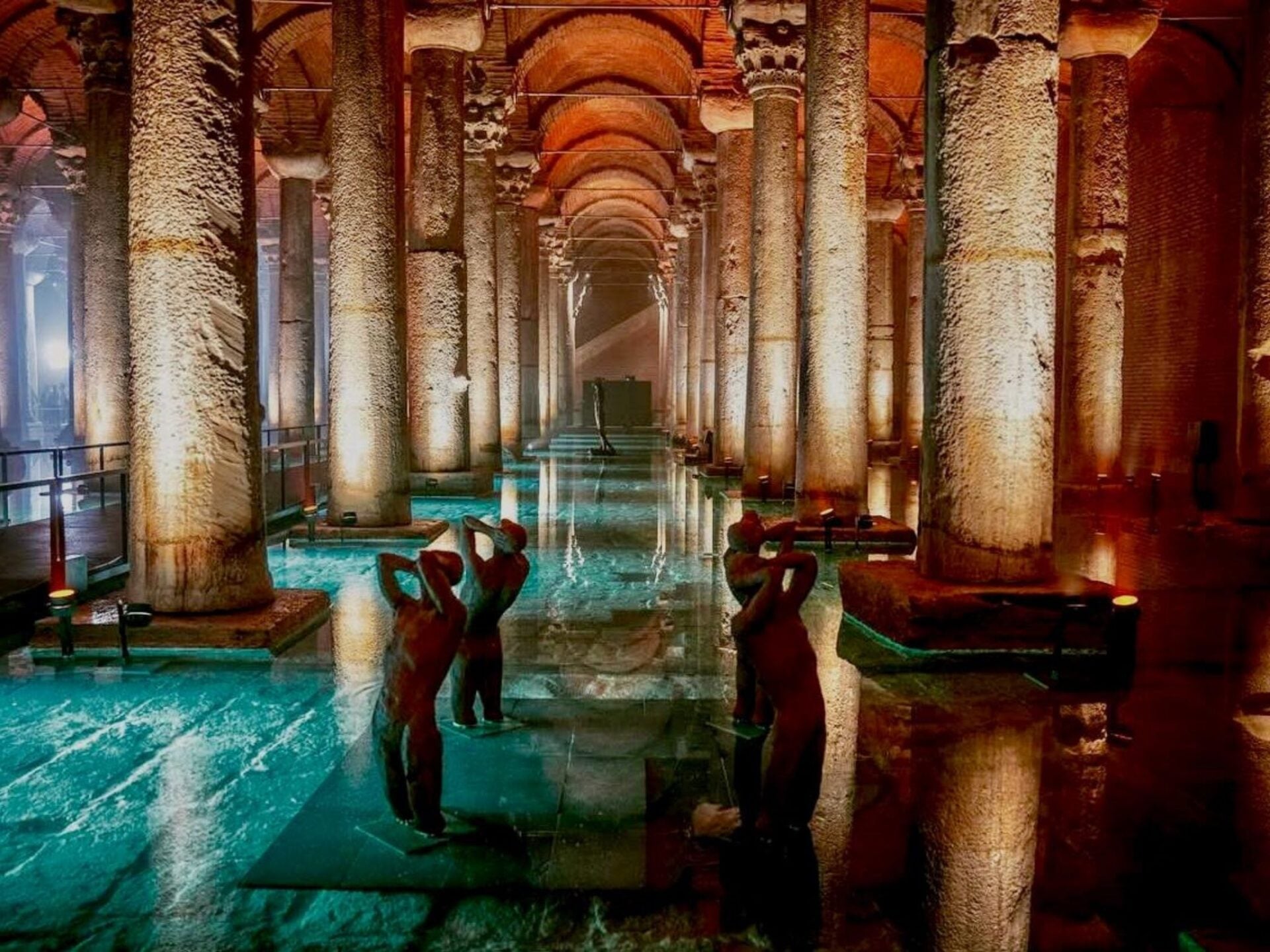
The 2022 renovation introduced a carefully designed lighting system that has fundamentally changed the experience of visiting the cistern. Gone is the flat, orange-tinted illumination of previous decades. In its place, a dynamic system bathes the columns in shifting pools of warm amber, cool blue, and soft white light, casting long shadows across the water surface and emphasizing the architectural details of each column capital. Certain areas are deliberately left in near-darkness, preserving the sense of mystery that has always been central to the cistern's character. The thin film of water that still covers portions of the floor serves as a natural mirror, reflecting the illuminated columns and producing visual depth that photographs only partially capture. At intervals, subtle audio elements — the recorded sound of dripping water, ambient tones — layer over the natural acoustics of the space, which is naturally reverberant in a way that muffles conversation and amplifies the sense of being underground.

Contemporary Art Installations
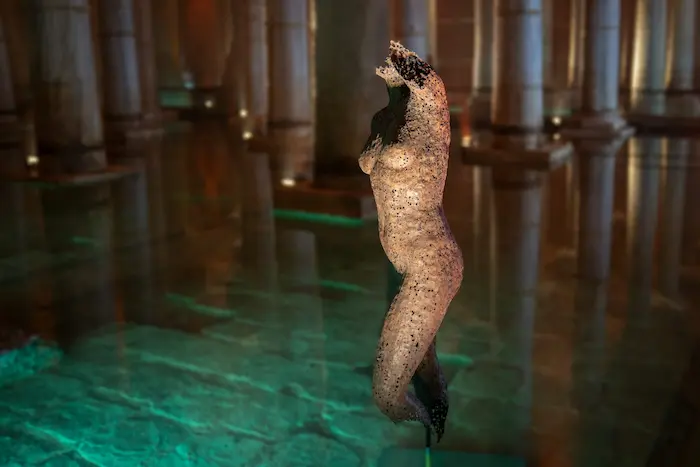
Since reopening, the Basilica Cistern has hosted a rotating program of contemporary art that uses the unique underground environment as a canvas. Past exhibitions have included immersive sound works, sculptural installations suspended from the walkways, and light-based pieces that interact with the water and stone surfaces of the cistern itself. The curatorial approach treats the cistern not as a static museum but as a living space where ancient architecture and modern creative practice coexist. These temporary exhibitions change on a regular schedule, so it is worth checking the official website before your visit to see what is currently on display. The combination of Byzantine engineering and twenty-first-century art creates a dialogue between eras that you will not find in any other Istanbul landmark.
Tickets & How to Visit
Everything you need to plan your entry, from ticket types to the best way to experience the cistern.
The Basilica Cistern is one of Istanbul's most popular attractions, and during peak season — April through October — queue times at the entrance can stretch beyond an hour. Choosing the right ticket type makes a significant difference to your experience.
Ticket Options Compared
| Ticket Type | Price (approx.) | Skip the Line | Guided Tour | Best For |
|---|---|---|---|---|
| Standard Admission | €30 | No | No | Budget visitors in off-season |
| Skip-the-Line Ticket Popular | €38 – €45 | Yes | No | Independent travelers, peak season |
| Guided Tour (English) | €50 – €65 | Yes | Yes (30 – 45 min) | History enthusiasts, first-time visitors |
| Combo: Cistern + Hagia Sophia | €80 – €100 | Yes | Yes (both sites) | Full Sultanahmet experience |
| Istanbul E-Pass / Museum Pass | €95 – €140 | Varies | Varies | Multi-day visitors seeing 4+ sites |
For most visitors, particularly during the busy months of May through September, a skip-the-line ticket is the best investment you can make. The price difference over standard admission is modest, and it eliminates what can be a punishing wait in the Istanbul heat. You simply present your mobile ticket or printed voucher at the priority entrance and walk straight in.
If you want the fullest understanding of what you are seeing, a guided tour adds enormously. A knowledgeable guide can point out architectural details you would otherwise miss, explain the Medusa head theories in context, and help you visualize how the cistern functioned as a working reservoir. English-language tours are widely available, though tours in German, French, Spanish, and other languages can be arranged through booking platforms.
Buying Tickets Online
We strongly recommend purchasing your tickets online in advance. This guarantees your entry time slot, secures skip-the-line access where applicable, and often provides a small discount compared to on-the-day prices at the box office. Book at least 24 to 48 hours ahead during peak season and at least a week ahead during public holidays.
Istanbul Tourist Pass® & Istanbul Prime Pass
For visitors looking for a more seamless and value-packed experience, the Istanbul Tourist Pass® is another excellent option. The Basilica Cistern is included in the pass, meaning you can enter without purchasing a separate ticket. The Istanbul Tourist Pass® is also included within the Istanbul Prime Pass, offering even more flexibility for travelers who want to bundle premium experiences.
With the pass, you benefit from a fully digital and hassle-free experience, including hosted entry and access to an audio guide, helping you better understand the history and significance of the Basilica Cistern. There's no need to wait in ticket lines or manage multiple bookings—simply choose your preferred time slot, arrive at the meeting point, and enjoy a smooth entry process.
Beyond the Basilica Cistern, the pass covers 120+ top attractions and experiences across Istanbul, making it an ideal choice for visitors planning to explore the city in depth. From iconic landmarks to guided tours and unique activities, it offers both convenience and excellent overall value.
If you're looking to save time, skip lines, and maximize your Istanbul itinerary, the Istanbul Tourist Pass® (and its inclusion within the Istanbul Prime Pass) is a smart and efficient choice.
Practical Information
Address, hours, how to get there, and what to expect once you arrive.
Opening Hours
Daily: 9:00 AM – 7:00 PM Last admission at 6:30 PM. Open every day of the year, including public holidays. Hours may be extended in summer (check the official website for seasonal updates).
Admission Prices
From €30 (standard) Skip-the-line from €38. Guided tours from €50. Children under 8 enter free. Istanbul E-Pass holders receive included admission. Prices subject to change.
Getting There
Sultanahmet Tram Stop (T1 Line) From the Sultanahmet tram stop, walk roughly 2 minutes north toward Hagia Sophia. The cistern entrance is on Yerebatan Caddesi, directly across from the southwest corner of Hagia Sophia. Look for the small stone building with the queue.
Visit Duration
30 – 45 minutes (typical) Self-guided visits average 30 to 45 minutes. Guided tours run 45 to 60 minutes. Photography enthusiasts may want to allow up to 90 minutes, particularly if you want to wait for clear shots at the Medusa heads.
Address
Alemdar Mh., Yerebatan Cd. 1/3 Fatih, Istanbul 34110, Turkey. The entrance is a modest stone building that belies the enormity of the space below. GPS coordinates: 41.0084, 28.9779.
Accessibility
Limited wheelchair access A ramp and elevator were added during the 2022 renovation. Main walkways are flat and wide. Some secondary paths remain narrow. Contact the venue in advance for the most current accessibility information.
Are you ready to explore the Basilica Cistern?
Unforgettable views and the best moments await you.
8 Tips for Visiting the Basilica Cistern
Practical advice from frequent visitors to help you make the most of your time underground.
Arrive at Opening or Late Afternoon
The quietest times are first thing at 9 AM when the doors open, or after 5 PM when the tour-group rush has subsided. Midday between 11 AM and 3 PM is consistently the most crowded period, particularly from April through October.
Bring a Light Jacket — It's Cool Down There
The cistern maintains a steady temperature of around 10 to 12 degrees Celsius (50 to 54 degrees Fahrenheit) year-round, regardless of what is happening on the surface. Even in the height of a sweltering Istanbul summer, you will want a layer when you descend. The sudden contrast between 35-degree streets and the cool underground air is significant.
Use Your Phone Camera, Not Flash
Flash photography is technically permitted, but it actually produces worse results in the cistern's carefully calibrated low lighting. Your phone's night mode or a camera set to high ISO with a slow shutter speed will capture the atmosphere far more faithfully. The reflections in the water, the shadow play between columns, and the amber glow of the spotlights all photograph better in natural conditions.
Visit on a Weekday Morning for the Best Experience
If your schedule allows, a Tuesday, Wednesday, or Thursday morning offers the most serene atmosphere. Weekend mornings fill quickly with both tourists and locals, and Friday afternoons tend to be quieter but the light installations may be in transition between programs.
Head Straight to the Medusa Heads
Most visitors follow the main walkway from left to right, which means the Medusa heads — located in the far northwest corner — get progressively more crowded as the visit continues. If you want a quiet moment with these extraordinary carvings, turn right immediately upon entering and walk directly to the back corner before doubling back.
Combine with Hagia Sophia and the Blue Mosque
The cistern entrance is literally across the street from Hagia Sophia, and the Blue Mosque sits in the park just beyond. You can comfortably visit all three in a single morning or afternoon. Start with the cistern at 9 AM, move to Hagia Sophia, then walk to the Blue Mosque. This keeps you in the Sultanahmet core without any transit.
Consider a Guided Tour for Context
The cistern is visually striking enough to enjoy on your own, but a good guide elevates the experience considerably. They can explain which columns came from which type of Roman building, describe how the water system functioned, and share the scholarly debate about the Medusa heads — context that is not always apparent from the signage alone.
Check for Temporary Exhibitions
Since the renovation, the cistern has hosted rotating contemporary art installations that add a new dimension to each visit. These exhibitions change regularly, and some are genuinely outstanding. Check the official Basilica Cistern website or social media channels before your trip so you know what to expect and can plan your time accordingly.
Nearby Attractions
The Basilica Cistern sits in the heart of the Sultanahmet Historic Peninsula, surrounded by Istanbul's most iconic landmarks.

Hagia Sophia
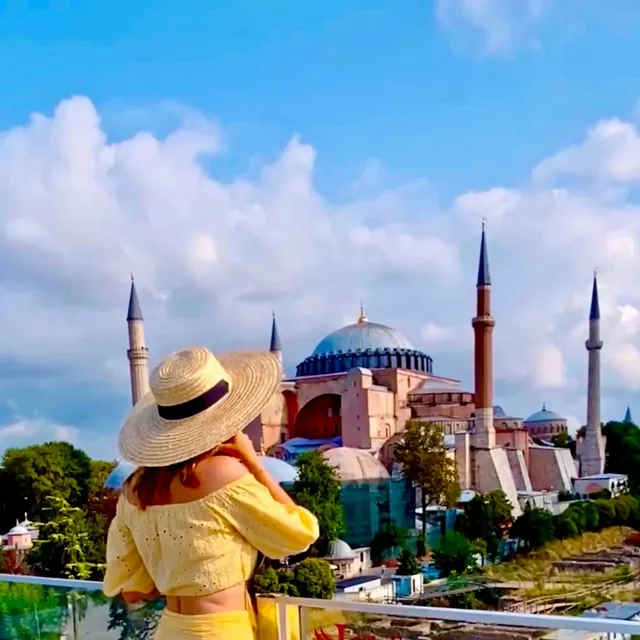
The Byzantine cathedral that redefined architecture, directly across the street from the cistern entrance. Built just five years after the cistern itself, the two share an emperor and an era.
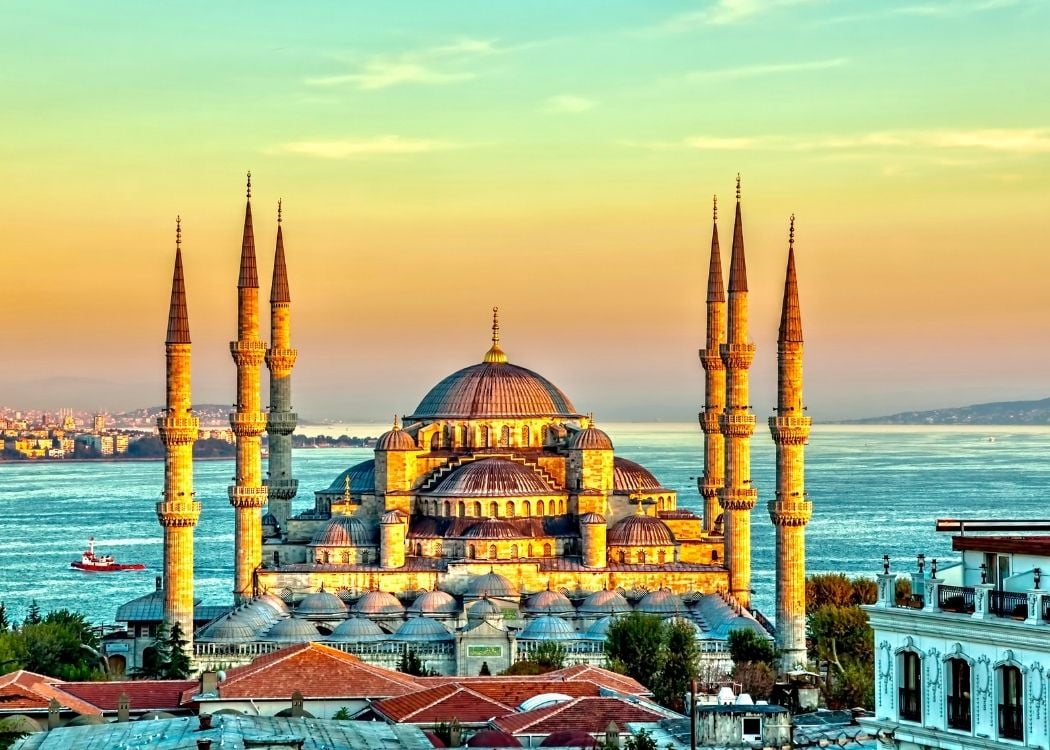
Blue Mosque
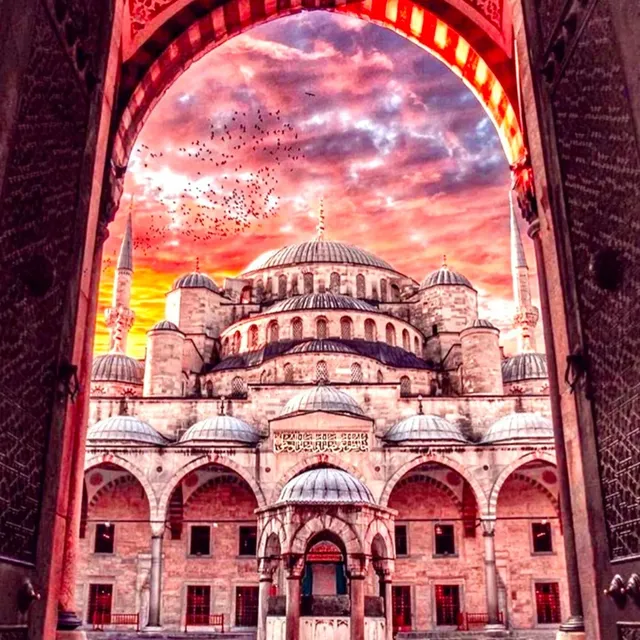
Sultan Ahmed's 17th-century masterpiece with its six minarets and cascading domes sits just south across the Hippodrome park. Free entry, but check prayer times before visiting.
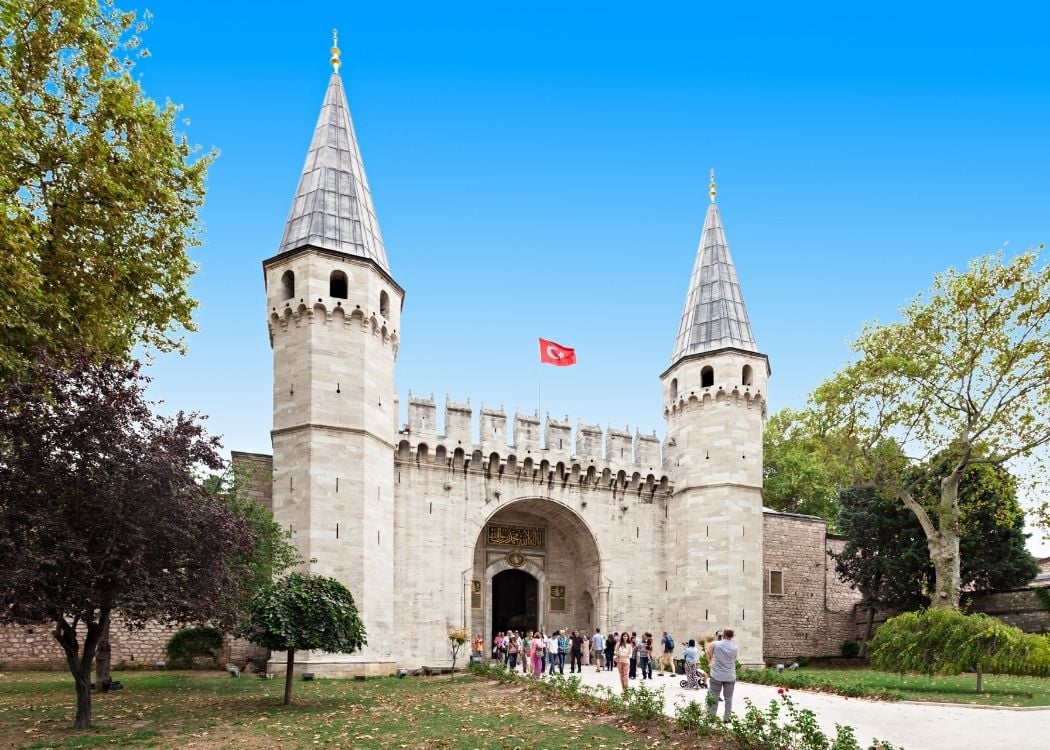
Topkapi Palace
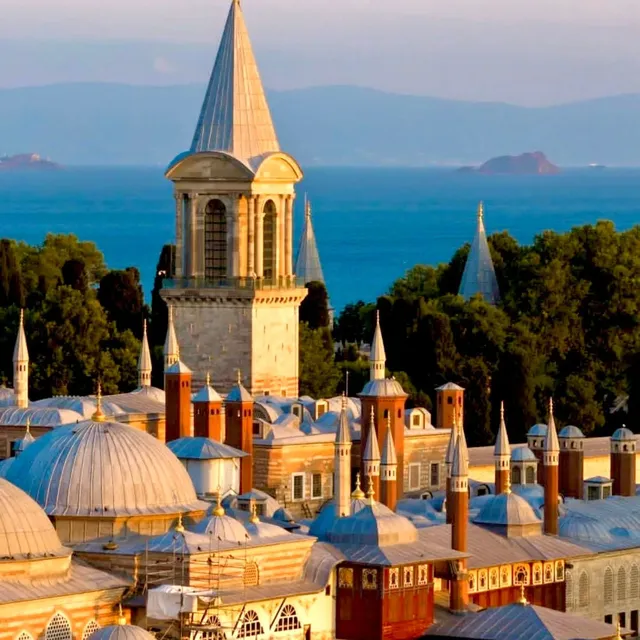
The Ottoman sultans' primary residence for four centuries. Walk through the palace grounds, treasury, and harem for a window into the empire that succeeded Justinian's Byzantium.

More Things to Do
From the Grand Bazaar to the Bosphorus cruise, Istanbul offers hundreds of experiences. Browse our curated selection of the city's best activities.
Frequently Asked Questions
Answers to the most common visitor questions about the Basilica Cistern.
Most visitors spend 30 to 45 minutes inside the Basilica Cistern. Self-guided visits tend toward the shorter end, while guided tours typically run 45 to 60 minutes. If you are a photography enthusiast or want to take your time absorbing the atmosphere, allow up to 90 minutes. The site is compact enough that you will not feel rushed in half an hour, but spacious enough to reward a longer stay.
The cistern has limited wheelchair accessibility. A ramp and elevator were installed during the 2022 renovation, and the main raised walkways are flat and reasonably wide. However, some secondary pathways and viewing platforms may be narrow or have uneven surfaces. Visitors with mobility concerns should contact the venue in advance at the official website to confirm current access conditions and any available assistance.
Yes, photography and video are both allowed for personal use. Flash is permitted but not recommended — the atmospheric lighting produces far better results without it. Tripods and professional filming equipment are not allowed without prior authorization. For the best photographs, use your phone's night mode or a camera with good low-light performance and lean against a railing for stability.
Absolutely. The Basilica Cistern is one of Istanbul's most distinctive attractions and consistently ranks among the top five things to do in the city. There is nothing else quite like it — the scale of the underground chamber, the variety of the ancient columns, the mystery of the Medusa heads, and the atmospheric lighting combine to create an experience that is both historically rich and genuinely moving. Even seasoned travelers who have visited dozens of historical sites tend to find the cistern memorable.
Two large carved Medusa heads serve as bases for columns in the northwest corner of the cistern. One is placed on its side, the other upside down. They are Roman in origin and were likely salvaged from another building. The reason for their unusual placement is debated: some scholars believe the orientations are purely practical (the blocks were sized to fit the column height), while others argue the positions were deliberate — either to neutralize Medusa's mythological power or simply because the builders treated pagan iconography as raw construction material.
Yes. The underground chamber maintains a constant temperature of approximately 10 to 12 degrees Celsius (50 to 54 degrees Fahrenheit) throughout the year. This is comfortable in winter but can feel surprisingly cold in summer when the street-level temperature may be 30 degrees or higher. We recommend bringing a light jacket or sweater, even during the warmest months.
The least crowded times are early morning right at the 9 AM opening or late afternoon after 5 PM. Weekday mornings, particularly Tuesday through Thursday, are significantly quieter than weekends. The busiest window is between 11 AM and 3 PM, when large tour groups arrive. During the off-season (November through March), the cistern is quieter at all hours.
Yes. Several combination packages are available that bundle the Basilica Cistern with Hagia Sophia, Topkapi Palace, and other Sultanahmet-area attractions. These combo tickets typically offer savings of 15 to 20 percent over individual admission prices and often include skip-the-line privileges at each venue. The Istanbul E-Pass and Istanbul Museum Pass are also options that cover multiple attractions over several days.
What Visitors Say
Experiences from travelers who have walked among the columns.