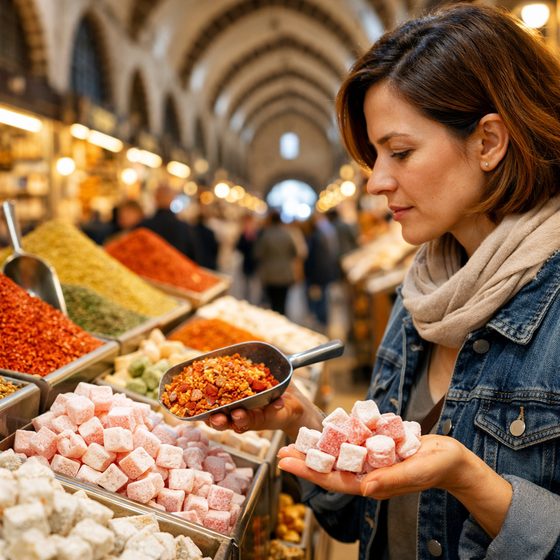

In the past, side streets across Istanbul were lined with specialty shops: offal shops for viscera, pastry shops for desserts, and pickle shops for pickles. Especially around Cemberlitas, Laleli, and Fatih, many of these shops once flourished. Hard financial conditions and increased competition caused many to disappear. Old names such as Cemberlitas Tursucusu, Tursucu Sukru, and Meraklı Tursucusu have closed. Still, a few continue this historical profession, among them Ozcan Tursuları in Kadikoy Fish Market, Soydan Tursuları across from Besiktas Fish Market, Uludag Tursuları in Fatih, and Pelit Tursuları in Kurtulus. Their neighborhoods also place them close to some of the city’s best-known areas, from the Grand Bazaar side of old Istanbul to the lively streets around Taksim Square. We visited these shops one by one and asked each the same question: How is the best pickle prepared, with lemon juice or with vinegar?
Famous pickle shops in Istanbul
Petek Pickleshop
Petek Tursulari is run by Halil Arı, originally from Konya, and has served the Beyoglu Fish Market for 35 years. He was once a partner of Pelit Tursulari and now continues the profession on his own. Among the shop’s famous customers are Kadir Topbas, Çetin Atlan, Mehmet Agar, Bulent Ersoy, Sibel Can, and Ata Demirer. In addition to classic pickles, Petek offers egg, mushroom, plum, okra, apple, pomegranate, corn, and melon skin pickles as specialties.
Halil Bey says pickles can be made with vinegar or lemon juice, together with salt. For gherkin, tomato, and Cengelkoy-style cucumber pickles, both vinegar and lemon juice are used. For cabbage and green pepper pickles, however, he says only salt should be added. Since his shop prepares pickles by the ton, he believes home cooks cannot easily achieve the same taste and advises housewives who want to make pickles at home to use only salt. His own conclusion is simple: they do not need to prepare it themselves when they can buy from him.
Ozcan Pickleshop
Ozcan Tursuları is one of the oldest shops in Kadikoy Fish Market, established in 1956. It is run by three brothers who inherited the profession from their father after years of apprenticing under him. The oldest brother, Bahattin Bey, recalls that in Kadikoy the best-known pickle makers were once Hakkı Usta and Mardif Usta.
The shop carries even 6 or 7 types of pepper pickles, including banana peppers, thin green peppers, and Albanian peppers. Bahattin Bey says both lemon juice and vinegar may be used in preparation, but the pickle made with lemon juice is for summer. Cengelkoy-style cucumber should especially be made with lemon juice, tomatoes with a little vinegar, and carrots without either vinegar or lemon juice. Since cabbage changes color, vinegar is never used for it; only salt is added.
He also remembers that in the past, young raw grape pickles were prepared in earthenware jars and buried in garden soil for protection. Like the other masters, he insists that homemade pickles will not taste as good as those from the shop, adding that just as he cannot cook like a housewife, housewives cannot prepare pickles as well as he can. He emphasizes that proper pickles are made from fruits and vegetables specially grown for pickling, not from produce bought from ordinary greengrocers, especially greenhouse-grown ones.
Soydan Pickleshop
Soydan Tursuları has served for four generations from its shop across from Besiktas Fish Market. Çetin Bey has run the business for eight years. The family migrated from Karabuk to Istanbul, began their pickle trade in Ortakoy, and later moved to Besiktas. Their specialties include pickles made from peach, young raw melon, plum, and cauliflower.
Soydan also prepares sweet pickles according to customer demand. Çetin Bey explains that sweet pickles have a shorter expiry period than standard pickles because when salt and vinegar are added, they turn sour more quickly. The shop has foreign customers from Germany and the United Kingdom, and its famous customers include Arif Susam, Mustafa Erdogan, Tugba Ozay, Ahu Turkpence, and players from Besiktas Football Team.
He notes that pickles can last a very long time in winter but should be consumed within a maximum of one month in summer. In natural pickles, a layer called kaymak forms on the top surface over time. This does not mean the pickles are ruined; it is simply salt from the mixture that has floated upward. For that reason, he recommends stirring the top layer of the jar with a spoon.
Uludag Pickleshop
Uludag Pickleshop, serving since 1950-1955, is one of the oldest surviving pickle shops in Fatih and is located on Yavuzselim Street. The business is run by a second generation of pickle makers who follow the traditional master-apprentice system.
Mehmet Gokkaya says the spread of supermarkets and pre-packed pickles has weakened their sector. He draws a clear distinction between their products and factory-made pickles. Industrial versions are pasteurized and prepared in a single day, with vegetables treated in boiling water and quickly placed in vinegar. Uludag’s pickles, by contrast, require at least one month of preservation.
The shop sources different fruits and vegetables from different cities including Izmir, Afyon, Tekirdag, and Bursa. For its pickles, vinegar is used as the main element, while lemon juice is added only in the amount requested by the customer.
Cabbage pickle recipe: Cabbage is one of the easiest vegetables to pickle. Approximately 1 kilogram of cabbage is sliced. To 1 liter of water, add 800 grams of rock salt. If desired, one fistful of chickpeas can also be added.
Pelit Pickleshop
Pelit Tursuları has operated on the main street of Kurtulus since 1968. Its pickles were once prepared in Eyup-Nisancılar, but because the climate and water were more suitable, the production site was moved to Gedelek Village. Metin Kurucay has worked for Pelit for around 10 years. The business, run and presented by Oktay Pelit, also has dealer shops in Kocamustafapasa, Ferikoy, and Besiktas.
Pelit offers 35 types of pickles. Okra, cauliflower, apple, pear, and watermelon are among its specialties. Metin Bey says pickles meant to be consumed in a shorter period are prepared with lemon juice, while those intended to last longer are prepared with vinegar. He also notes that Cemil İpekci, Bülent Ersoy, and Savas Ay are among their famous customers. After the film Neseli Gunler aired on television, many people reportedly rushed into their shops to buy pickles.
According to Metin Bey, the traditional way of making pickles is slowly dying because of hypermarkets, delicatessens, and cheap factory-made products. Still, for those who seek the taste of true pickles made with natural ingredients, traditional pickle shops will survive.
Cucumber pickles from Haci Abdullah Restaurant
Located on a side street near Aga Camii on Istiklal Street, Hacı Abdullah restaurant has operated since 1888 and is one of Istanbul’s best-known restaurants. It is especially famous for Ottoman cuisine and serves remarkable varieties of pickles. The restaurant prepares its own pickles using vegetables purchased from the same supplier for about 70 years. From cardoon to oak acorn, gherkin, and eggplant, the range is broad.
Abdullah Bey, who has worked in the restaurant sector for more than 45 years, recalls that every district of Istanbul once had well-known pickle shops. He immediately remembers Şükrü in Carsıkapı and Tahir in Besiktas. Unlike several shop owners, he insists that the taste of the pickles mothers used to make at home can never truly be replaced by shop pickles, and he shared a recipe for a type of pickle we could not get elsewhere.
Cucumber pickle recipe: Wash 1 kilogram of cucumber. Add 750 grams of vinegar and several garlic cloves. Depending on the season, leaves of celeriac or, if unavailable, some parsley may be added. After adding a fistful of chickpeas, add 400 to 450 grams of rock salt and close the glass jar tightly. After waiting 15 to 20 days, the pickle is ready to serve.
For broader background on pickling and its long culinary history, see Wikipedia’s overview of pickling. If you want to explore more of Türkiye’s food culture, the official tourism portal GoTürkiye is also a useful resource. And if your food walk takes you through old commercial quarters, the nearby Spice Bazaar offers another classic taste of Istanbul’s traditional food trade.