Anatolian Fortress history on the Bosphorus
The Anatolian Fortress stands at a strategic point where the Göksu brook meets the Bosphorus. Its position made it highly valuable in Ottoman military planning, especially during the final stages leading to the conquest of Istanbul. Together with the fortress later built across the strait, it formed part of a wider effort to control movement on this crucial waterway.
The major function of the Anatolian Fortress during the siege of Istanbul was, like that of Rumeli Fortress, to help ensure control of navigation through the strait. In the years following the conquest of Istanbul, both fortresses also played an important role in preventing threats coming from the Black Sea and in securing Turkish sovereignty in the Bosphorus.
Architecture of the Anatolian Fortress
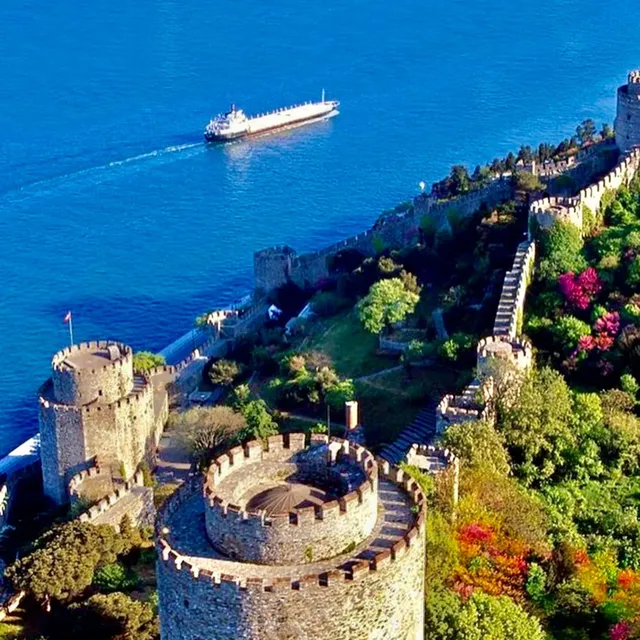
The Anatolian Fortress can be considered a typical example of Ottoman military architecture. In its construction, bricks were used alongside square-cut block stones. The main structure of the fortress, established on a narrow area by the water, is centered on a high rectangular tower.
This tower functions as an inner castle and is enclosed by walls. The tower and the inner wall are strengthened by a second rampart, while bastions surround these ramparts to create an outer defensive layer. In overall form, the complex consists of the main castle, the inner rampart, the outer rampart, and three secondary towers.
Why the fortress still matters today
Beyond its military history, the fortress remains important as part of Istanbul’s layered urban and cultural landscape. Today, the fortresses are counted among the landmarks that add distinctive beauty to the Bosphorus silhouette. Their presence also helps visitors understand how geography, defense, and imperial ambition shaped the city’s history.
If you are exploring the Bosphorus, the site gains even more meaning when considered alongside a Bosphorus Cruise, which offers a broader sense of how the strait connected and divided the city through the centuries. You may also wish to compare it with nearby waterfront heritage such as Beylerbeyi Palace, another important stop on Istanbul’s Asian shore.
Visiting and learning more
The fortress is best appreciated as a historic Bosphorus landmark and as part of the paired defensive system completed by Rumeli Fortress on the European side. For general historical background, see Wikipedia’s overview of Anadolu Hisarı. For broader Istanbul travel planning, GoTürkiye provides official destination information.
Whether you approach it for its architecture, strategic location, or place in the story of the conquest of Istanbul, the Anatolian Fortress remains one of the city’s notable monuments on the water.
FAQ about Anatolian Fortress
Where is the Anatolian Fortress located?
The Anatolian Fortress is located in Beykoz on the Asian side of Istanbul, directly on the Bosphorus. It stands near the point where the Göksu brook flows into the strait, giving it a highly strategic position in the city’s historic geography.
Why was the Anatolian Fortress built?
It was built under the edict of Bayezid I as an auxiliary military structure to support the siege of Istanbul during the Byzantine period. Its location helped the Ottomans strengthen control over movement through the Bosphorus.
What is the connection between Anatolian Fortress and Rumeli Fortress?
Rumeli Fortress was built in 1452 on the opposite side of the Bosphorus under Fatih Sultan Mehmet. Together, the two fortresses helped control navigation through the strait and formed an important defensive system before and after the conquest of Istanbul.
What are the main architectural features of the fortress?
The fortress includes a high rectangular tower, inner walls, a second rampart, surrounding bastions, and three secondary towers. Built with square-cut stones and brick, it is regarded as a typical example of Ottoman military architecture.