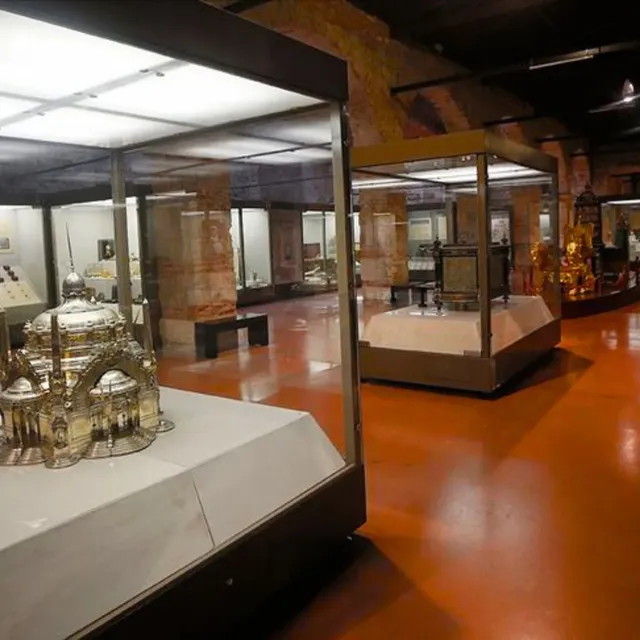
What to Find at the Istanbul Archaeological Museum
The desire to gather historical artifacts in Istanbul goes back to the time of Mehmet the Conqueror, but the official foundation of the Istanbul Archaeological Museums as Müze-i Hümayun in 1869 marks the beginning of museum history in the empire. The Müze-i Hümayun, which contained archaeological works collected in Hagia Irene, forms the starting point of the Istanbul Archaeological Museums story.
Because Hagia Irene became inadequate for the growing collection, the Tiled Kiosk, built during the reign of Mehmet the Conqueror, was converted into a museum. The Tiled Kiosk was restored and reopened in 1880, and it is still one of the key parts of the museum complex today.
In 1881, the appointment of Osman Hamdi Bey as museum director became a turning point in Turkish museology. Between 1887 and 1888, he excavated at Mount Nemrud, Myrina, Kyme, other Aiolian necropolises, and the Lagina Hekate Temple. After his excavations in Sayda (Sidon), he returned to Istanbul with several sarcophagi from the Sidon King Necropolis, including the famous Alexander Sarcophagus.
The earliest building in the complex is the Tiled Kiosk, dated to 1472 CE. Today, the Tiled Kiosk Museum displays examples of Turkish tiles and pottery and stands as one of the earliest examples of Ottoman civic architecture.
History of the Istanbul Archaeological Museums
The Istanbul Archaeological Museums are considered among the top museums in the world established specifically to serve as museums. In 1883, Osman Hamdi Bey founded the Sanayi-i Nefise College, or Academy of Fine Arts, in the building that today houses the Museum of the Ancient Orient. The structure was designed by Alexandre Vallaury, who would later design the classical building of the Archaeological Museum as well.
The Archaeological Museum is one of the few museums built during that period specifically as a museum building. It is also one of Istanbul’s most elegant neo-classical structures. On the pediments above the entrance, the inscription “Asar-ı Atika Müzesi” appears in Ottoman Turkish, meaning Museum of Antiquities. The tughra on the inscription represents Sultan Abdulhamid II.
The arrival of the Alexander Sarcophagus, the Sarcophagus of the Mourning Women, the Lycian Tomb, and the Tabnit Tomb from the Sidon excavations created the need for a new museum building. The classical building of the Istanbul Archaeological Museum, designed by Alexandre Vallaury, opened on June 13, 1891, directly across from the Tiled Kiosk.

Main Sections of the Complex
The museum complex is made up of three principal sections, each offering a different perspective on the region’s long history:
- Archaeology Museum: known for its monumental finds and sarcophagi, including the Alexander Sarcophagus.
- Museum of the Ancient Orient: focused on works from ancient Near Eastern civilizations.
- Tiled Kiosk Museum: home to Turkish tiles, ceramics, and one of the oldest Ottoman civic buildings in the city.
Together, these three sections make the complex one of the most rewarding museum visits in the historic peninsula.
Location of the Istanbul Archaeological Museum
The complex stands in the Sultanahmet neighborhood of Fatih, on the historic peninsula, on Osman Hamdi Bey Hill between Gülhane Park and Topkapi Palace. You can reach it either by walking down the slope from Topkapi Palace’s first court or by walking uphill from the main gate of Gülhane Park. Because of its central setting, the museum is easy to combine with nearby landmarks such as Sultanahmet Square.
For background on the museum’s international cultural significance and context, you can also consult UNESCO. For general historical reference, Wikipedia provides an overview as well.
Why Visit
If you are interested in archaeology, imperial collecting, Ottoman cultural history, or simply want to see one of Istanbul’s landmark museum complexes, this is a rewarding stop. The museum’s importance comes not only from the scale of its collection but also from its role in the development of museum culture in the Ottoman Empire and modern Turkey.
Its location near Hagia Sophia and Topkapi Palace also makes it an easy addition to a day of sightseeing in the old city.
Explore More of Istanbul
Istanbul.com keeps you up to date on some of the most interesting places in the city. You can discover more things to do in Istanbul, explore major historical sites, and plan visits to other museums and attractions across the city. If you want to continue your route after the museum, the surrounding Sultanahmet area offers some of Istanbul’s most important landmarks within walking distance.
FAQ
What is inside the Istanbul Archaeological Museum complex?
The complex includes three main sections: the Archaeology Museum, the Museum of the Ancient Orient, and the Tiled Kiosk Museum. Together, they preserve artifacts, sarcophagi, tiles, pottery, and archaeological material gathered from different civilizations.
Who founded the Istanbul Archaeological Museums?
Osman Hamdi Bey played the key role in shaping and developing the museums in the late 19th century. He was not only a museum director and archaeologist but also an important painter and a leading figure in Turkish museology.
Where is the Istanbul Archaeological Museum located?
The museum complex is in Sultanahmet, Fatih, on the historic peninsula. It sits between Gülhane Park and Topkapi Palace, and it can be reached on foot from either direction.
What are the most famous works in the museum?
Among the best-known works are the Alexander Sarcophagus, the Sarcophagus of the Mourning Women, the Lycian Tomb, and the Tabnit Tomb. These were brought to Istanbul following Osman Hamdi Bey’s excavations in Sidon.
Is the Tiled Kiosk part of the museum?
Yes. The Tiled Kiosk is one of the three main parts of the complex. It is also the earliest building in the museum group and is important both for its collection and for its architectural value.